


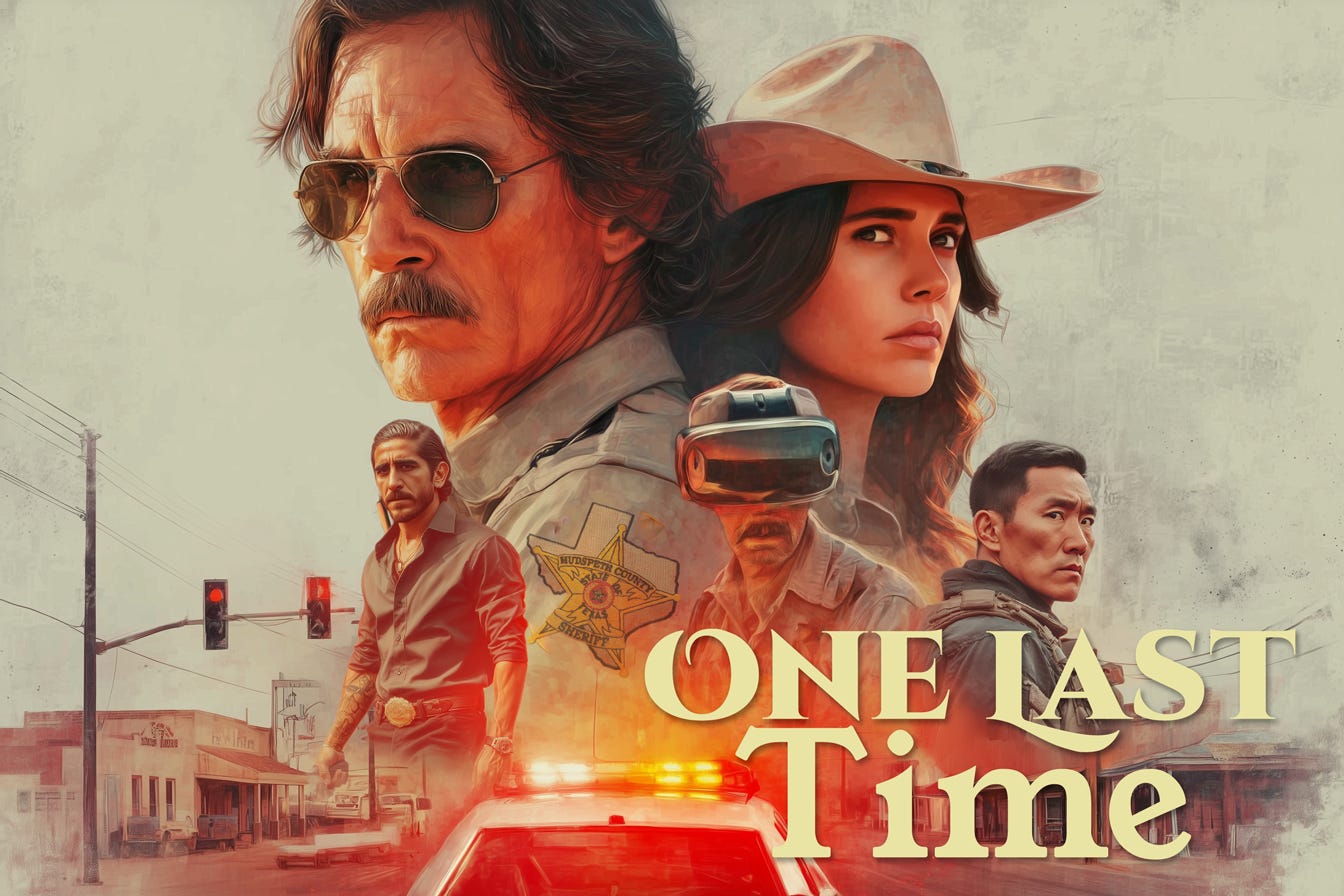
Now, I’d never been much of a prayin’ man. Not even before Hannah died. Me and Hannah had sat in Sunday church often enough, for sure. We had stood when folks stood, bowed when folks bowed, and sang hymns about grace with our names printed in neat little bulletins like decent folks do. But most Sundays, if I was tellin’ it square, I had treated the Lord like a fella you nod at from across the room. Respectful. Civil. Kept my distance. Hannah had more religion in the hem of one church dress than I ever carried in my whole hide.
But right there with a half-dozen rifles trained on me and more just beyond, I prayed silent all the same.
Lord, I thought, not knowin’ whether I had any right to use the word with as little practice as I had, if You ever meant to help a stubborn fool, now might be a right fine time.
Boy, it was an ugly prayer. Desperate. It had no polish to it. No holiness worth admirin’. It was just a busted-up man beggin’ under his breath where nobody could hear him but God. I didn’t even know if God wanted to hear from me or not.
But prayin’ seemed like about the best thing to do standing there with a hundred rifles pointed at me.
Then the whole intersection went still.
Not quiet exactly. There was too much breathin’ for quiet. Too much wind hissin’ through ditch grass. Too much leather creakin’, engines tickin’, gravel crunchin’ under boots, and rifles settlin’ against shoulders. But inside all that noise, there came a kind of stillness anyhow. The sort that settles over a room right before a doctor says whether the patient made it. The sort that hangs over a church altar right before a man comes up outta the baptismal water.
Nothin’ was more still than Captain Ron Masters.
He just stood there in the middle of Sparkwood and 21 with the red light blinkin’ over one shoulder and a ring of United States soldiers spread around me like a steel trap God Himself might’ve set. He watched me with that same hard, measured face of his, but something in his eyes had shifted. Not softened exactly. Men like him did not soften easy. But he had gone inward some. Like he was sortin’ through an old drawer in the back of his mind and finding things he had not planned on layin’ hands on tonight.
Mari noticed it too. I could tell by the way she stopped pleadin’ for half a breath and turned her attention from me to him.
The rifles stayed up.
That was the part that made the whole thing feel a touch crazy. Every barrel in that circle still pointed at my chest or my head or the machine in my hand. Red dots trembled faint across my shirt when the men shifted their stance. The Army had not forgot what they were here for. They had not forgot who I was neither. I was still the county sheriff who had run with classified equipment, ignored federal command, slipped a roadblock, and dragged half of Texas’ trouble to a lonely county-line stoplight for the sake of a dead woman.
And yet there I stood.
Still askin’.
Then somethin’ glinted off the captain’s chest in the light. It half blinded me for a spell. I noticed it was a silver cross he wore around his neck. Then I half-wondered if that were a sign from the Almighty.
Masters finally spoke.
“You are asking a great deal.”
His voice had gone lower. The soldiers nearest him glanced his way but did not move. He kept his eyes on me. “You have already compromised an operation, endangered personnel, and prolonged possession of a device you do not understand.”
“I understand enough,” I said. “Enough to know how the cards are laid out.”
Mari made a rough sound in her throat. “Dallas—”
I kept my eyes on Masters.
“This ain’t about me makin’ a break for it. You know that. If I meant to run, I’d have done it already.” I lifted the TRG just enough for him to see I still had hold of it and no intention of droppin’ it from fear. “I came here for one reason. You already know the reason. You looked me up, remember?”
That landed.
His jaw tightened once, then eased. He looked past me toward the patch of highway where Hannah’s blood had dried a year before. I could not have known all that moved through his head in that moment by normal means. But I know now what a man looks like when memory reaches up and takes him by the throat. He wore that look plain as a scar.
When he spoke again, there was less government in him.
“My mother died a few years ago,” he said.
Mari’s head turned sharp toward him.
Mine did too.
He did not seem embarrassed by sayin’ it. That made it hit harder. He spoke like a man layin’ a service weapon on the table. Careful. Deliberate. Not for drama. Just because the moment required honesty more than posture.
“Cancer,” he said. “Fast, ugly, unfair. By the time they found it, there was nothing to be done. I was on duty when the call came. I made it to the hospital too late to hear a final word. Too late to say one back.” He paused, and for the first time that night the captain looked less like an officer than a son who had failed an appointment with grief. “I spent years imagin’ what I might have said if I’d been given five more minutes.”
The wind slid across the intersection. Somewhere behind the soldiers, an engine ticked as it cooled.
Mari stared at him like the man had suddenly sprouted wings.
I said nothing. There weren’t words handy enough for that sort of admission.
Masters drew a slow breath. “Do not mistake me, Sheriff. I still believe those goggles must be surrendered immediately. I still believe they are a threat to national security, public order, and likely to any soul foolish enough to use them twice.” He glanced down at the TRG in my hand like he hated its very shape. “But I also believe a nation that asks men to bleed for it accrues certain debts.”
The red light blinked. On. Off. On again.
He looked me dead in the eye.
“You served your country. Honorably. And tonight that country has brought rifles to bear on a grieving sheriff at the exact place his life split in two.” His face stayed stern, but there was a line of mercy in it now. “We owe you at least this much.”
Mari said, “Captain…” and there was naked shock all through the word.
One of the soldiers to my left shifted like he thought he had misheard.
Masters raised one hand without looking away from me. “Let the sheriff move to that side of the intersection.”
Not lower your rifles. Not relax. He was too seasoned for that. But the order moved through the ring all the same. It did not undo the danger. It just changed its shape. A few muzzles dipped an inch, then came back to ready. Men adjusted their footing. Nobody broke discipline.
Mari looked from him to me and back again. She was still shocked, but there was something else mixed in now. Relief, maybe. Or fear in a different hat. She knew as well as I did that gettin’ what you want is sometimes the last mercy before your heart gets broke proper.
I wet my lips. My mouth had gone dry as cotton.
I searched his face for the trick in it. For the trapdoor under the words. For the little curl at the edge that would tell me this was just a tactic to get my guard down so they could dogpile me in the road.
Didn’t find it.
“Five minutes,” he said. “No more. You do not move beyond the crash site. You do not attempt escape. You do not alter the device settings beyond what you need to view the event.”
My thumb tightened against the TRG. “And after?”
“After,” he said, “you hand it to me.”
That was fairer than anything I had a right to expect.
I gave him a small nod. It was not gratitude exactly. Not yet. I was too wrung out and too close to the edge for gratitude. But it was the nearest cousin I had in reach.
Then I turned toward the place where Hannah had died.
You could feel the whole line tense when I moved.
I pulled the TRG up slow. Slow enough no trigger finger got nervous. Slow enough every man there could see I wasn’t drawing a pistol or trying some last wild stunt out of a dime-store western. The black frame caught the blinking red light and turned it mean. The little dial sat under my thumb like the tick of a snake’s rattle.
And then I started walkin’.
The soldiers parted.
Not all at once. Not dramatic like in the movies. It happened in measured steps, disciplined and uneasy, each man moving only enough to preserve angle and distance while keeping his rifle trained on me. But from where I stood, it looked like the sea itself had decided to split down the middle for one grief-struck idiot in a sheriff’s uniform.
Boot by boot, they made a lane.
I walked through it.
The gravel popped under my soles. The night air felt colder the nearer I got to the black patch of roadway where memory and blood and regret had all once met under a flashing light. I could feel Mari’s eyes boring a hole in my head. Could feel Masters watching every inch of my hands. Could feel a hundred pounds of government hanging on what I did next.
But under all of that, stronger than the fear and stronger than the shame, there was one awful, shining thing.
Hope.
Not healthy hope neither. Not Sunday-school hope with soft edges and hymn music behind it. This was desperate hope. Ragged hope. The kind that crawls out of the grave with dirt in its teeth and says maybe one more look won’t kill you after all.
I reached the edge of the crash site and stopped.
The road looked ordinary. That was the cruelest part. Just blacktop. Faded striping. Gravel shoulder. Ditch grass moving in the wind. No blood. No twisted metal. No shattered glass. Nothing left but a patch of Texas highway and what a man knew had happened there.
Behind me, nobody said a word.
I set my boots. Drew one long breath. Then another.
My fingers found the dial.
One year minus one day.
The TRG gave a faint hum in my hands.
A little light shivered alive inside the frame.
Every hair on my arms rose.
I lifted the goggles toward my face.
And just before I put them on, the device woke for real.
Tune in next week for Chapter 7 – Part C. Take Advantage of this limited offer from Creation Press. The first 100 free subscribers will automatically be upgraded to a paid account for one year.