


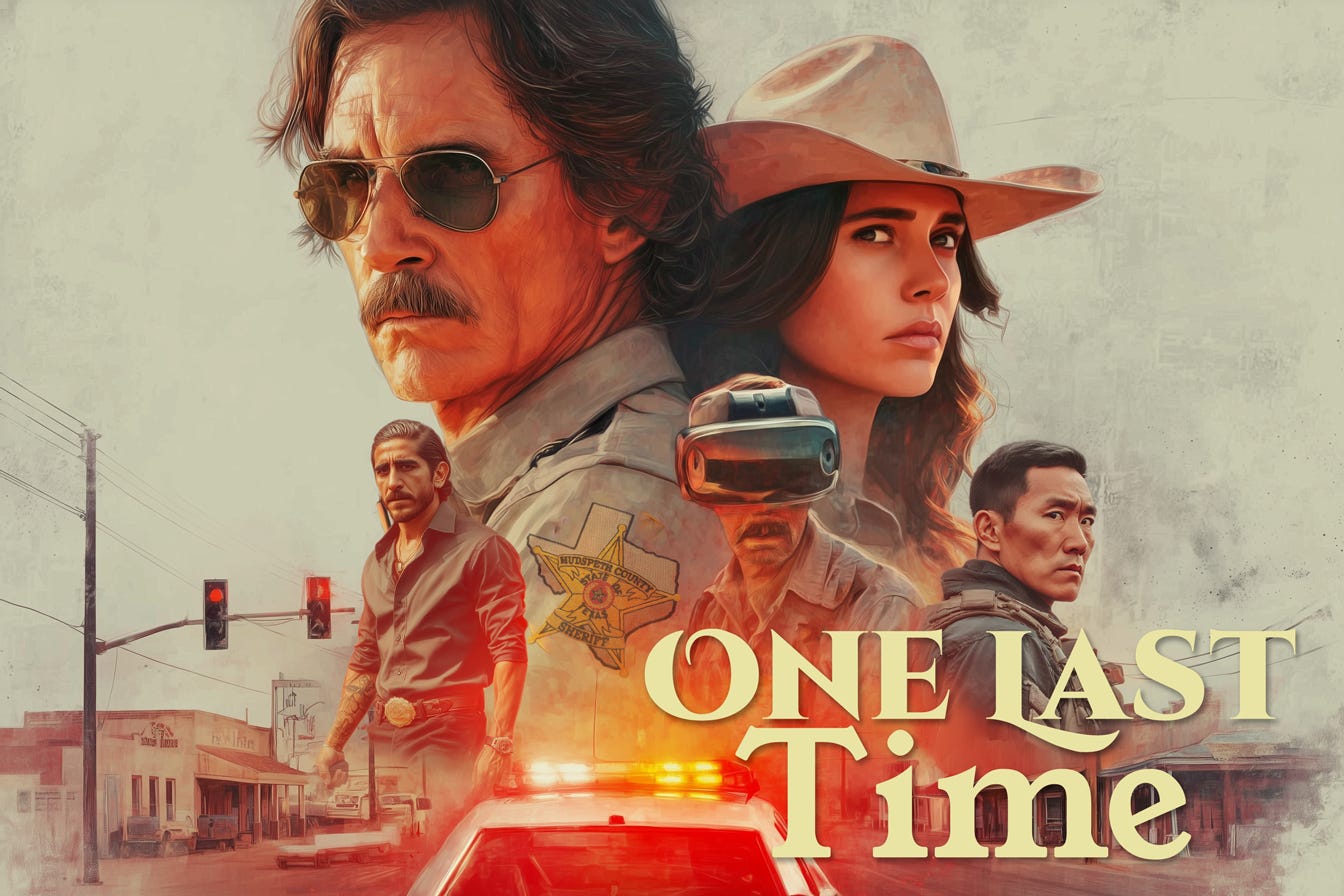
I tucked the case tight under my arm, flattened myself to the floor, and started crawling toward the exit.
That hallway felt longer than a Baptist sermon on Hell. Every inch of it was lit in ugly little flashes from the gunfight outside. White bursts came through the busted front of the station and flickered off the scuffed baseboards, the bulletin board by the supply closet, the old framed photograph of former Sheriff Wilkes shaking hands with the governor. Plaster dust hung in the air so thick I could taste it. Every breath came gritty. Behind me, Mary whimpered once, then bit it back. Lucas muttered a prayer that sounded half holy and half panic. Mari stayed low and mean and steady, one hand wrapped around her sidearm, eyes skipping from the front window to me and back again like she was trying to guard two disasters at once.
I crawled past the copy room, past the narrow table where folks set potluck casseroles when somebody in town died, and that thought hit me wrong. A casserole dish had shown up at my house the day after Hannah died. Chicken spaghetti. Still wrapped in foil. I had left it on the counter till it spoiled because grief can make a man useless in ways that don’t even look dramatic. It can make him stare at rotten milk and not move. It can make him sit and listen to his own breathing because going inside a quiet house feels harder than facing a drunk with a shotgun. Mari had eventually thrown the casserole away.
The memories weren’t helpful. I shoved the thought down and kept moving.
The side hall bent near the rear offices. The exit door sat there with its narrow wired-glass window blacked out by dusk beyond. My cruiser was somewhere on the other side in the side lot, not ten yards off if memory served me right. Ten yards ain’t much under normal circumstances. Under rifle fire, ten yards can stretch into eternity.
A fresh volley cracked outside—hard and close enough to buzz the cinderblock walls. Then came a scream in Spanish, cut short by another burst. Right after that I heard a voice barking orders sharp and clipped—Chinese, no mistaking it now. They were close. Too close.
I slid up beside the rear records room door and risked a glance back.
Mari had Mary by the elbow and Lucas by the shirt sleeve, already pulling them toward cover deeper in the station while keeping her body half turned toward me. Her eyes found mine through the dim and dust. She didn’t say a word. Didn’t have to. There was a whole argument in that look. Anger. Fear. Loyalty. The kind of helplessness that comes when you know somebody’s fixing to do a foolish thing and you also know it might be the only thing left to do.
I gave her one nod.
She answered with the smallest shake of her head.
Then the front of the station erupted again. A burst stitched across the outer office. Wood splintered. Glass rained. Somewhere up front a computer monitor crashed to the floor. Mari jerked Mary and Lucas fully into the records room and kicked the door half shut behind them.
That was my opening.
I rose into a crouch, reached for the panic bar, and whispered something that might’ve been a prayer or might’ve just been my nerves leaking out through my teeth.
Then I shoved the door open and broke for the cruiser.
The dusk hit me all at once—hot, smoky, loud as hell.
The side lot was lit by a mess of clashing light. Streetlights washed the brick wall of the station in dirty yellow. Red and blue from one of our patrol units spun wild across the alley and painted everything with crazy moving color. Smoke drifted through it all in ragged sheets. The air smelled like hot metal, gasoline, gunpowder, and that awful stink of fear men bring with ’em when they know dying is knockin’ on the door.
I ran bent low, boots slamming asphalt, the case jammed under my arm. My cruiser sat two parking spaces down with the driver-side door toward me. I was halfway there when shots cracked from the street side of the building and sparks jumped off the rear fender. Somebody had seen movement.
I dove behind the cruiser hard enough to bruise bone.
Rounds smacked the vehicle in mean little punches. Safety glass starred. One bullet took the side mirror clean off and sent it spinning across the lot. I pressed myself to the gravel and peeked under the frame toward Main.
That was when I saw the whole busted circus sprawled out on Main Street.
Two factions were tearing up my town like it was a throwaway patch of dirt halfway around the world. On one side of the street, behind a black SUV and the wrecked, bullet-ridden shell of Mary’s sedan, crouched cartel men in dark shirts and tactical vests, hollering in Spanish and firing wild, angry strings whenever anything moved. On the far side, using storefront columns and the engine block of a dark armored SUV for cover, were the Chinese—cleaner movement, tighter formation, rifles shouldered like they were born there. Their fire came in disciplined bursts, efficient as a machine.
And right in the middle of that mess, lit by muzzle flashes and neon from the liquor store sign, were the two men who seemed to be at the center of this little war.
Now, I didn’t know these men from Adam at that point. Later I learned who they were. Colonel Wei Zhang of the Chinese Communist Party Army, and Cartel Lieutenant Álvaro Delgado of the Jalisco New Generation Cartel.
Colonel Zhang stood near the hood of the military truck, one hand signaling his men while the other held his rifle tight to his shoulder. Even from that distance I could see the cold command in him. Lean frame. Straight posture. Face set like he’d carved duty into the bone and left no room for mercy. He shouted something in Chinese and two of his men shifted at once, smooth as butter.
Across from him, half shielded by the open door of the black SUV, the big Jefe Álvaro Delgado moved like a man too vain to believe death would really take him. Flashy belt buckle catching light even in a firefight. Trim beard. White teeth showing every time he barked orders at his gunmen. He fired one-handed around the door, then ducked back with a look that said he was mad as a wet cat and twice as dangerous. He was clearly in charge. When his elementos saw him give orders, they obeyed.
Neither one of them had noticed me yet.
That changed when I made my move.
I sucked in one breath, grabbed the cruiser handle, and yanked the door open. The dome light blinked on.
“Shit.”
I looked in their direction and saw their heads all jerk in my direction. I flung the case across the passenger seat, slid in behind the wheel, and pressed the ignition switch.
The engine roared.
That sound cut through the gunfire like a preacher cussing in church.
Wei Zhang’s head finally snapped toward the lot. Fast. Precise. His eyes found me through the windshield in the same instant Delgado twisted around from behind the SUV door and saw the cruiser lurch alive.
For one frozen heartbeat, the whole war seemed to notice me at once.
Zhang pointed straight at my cruiser and shouted something sharp enough to shave paint.
Delgado’s face changed from fury to recognition to pure naked greed. He leaned out from cover and hollered, “¡El sheriff! ¡Las gafas!”
The sheriff. The goggles.
Well now, I thought, my dance card was full.
Bullets came in from both sides.
The windshield crazed on the passenger side. A round tore through the rear quarter panel. Another rang off the hood with a metallic scream. I dropped low over the steering wheel, slammed the cruiser into reverse, and punched the gas.
The SUV lurched backward hard enough to chirp tires and nearly clipped the dumpster by the alley fence. I cranked the wheel, shoved it into drive, and stomped down again. Gravel spit. The cruiser fishtailed through the side lot and shot toward the mouth of the alley.
I hit the mouth of the alley so fast the suspension bottomed out. The cruiser bounced, caught, and blasted onto the side street behind the station. Trash cans toppled in my wake. A newspaper box exploded as I clipped it with the bumper. In the rearview mirror I saw men spilling into motion from both sides of Main—Chinese soldiers converging with machine precision, cartel gunmen scrambling hot and reckless, all of them pivoting toward the same thing.
Me.
The case slid on the passenger seat. I slapped a hand over it to keep it from tumbling and got a good look at my own fingers in the dash light. They were shaking. Not from fear. Adrenaline. I could’ve gassed up my cruiser with it.
I’m this side of the dirt still. Not sure how much longer that’ll be. I had to move fast and be smart. I had to get there by midnight tomorrow.
Sparkwood and Route 21.
I bared my teeth, gripped the wheel, and mashed the pedal to the floor.
That’s when I looked down at the dash and noticed my cruiser was almost out of gas.
Tune in next week for Chapter 4 – Part A. Take Advantage of this limited offer from Creation Press. The first 100 free subscribers will automatically be upgraded to a paid account for one year.
Chapter 4…Please!